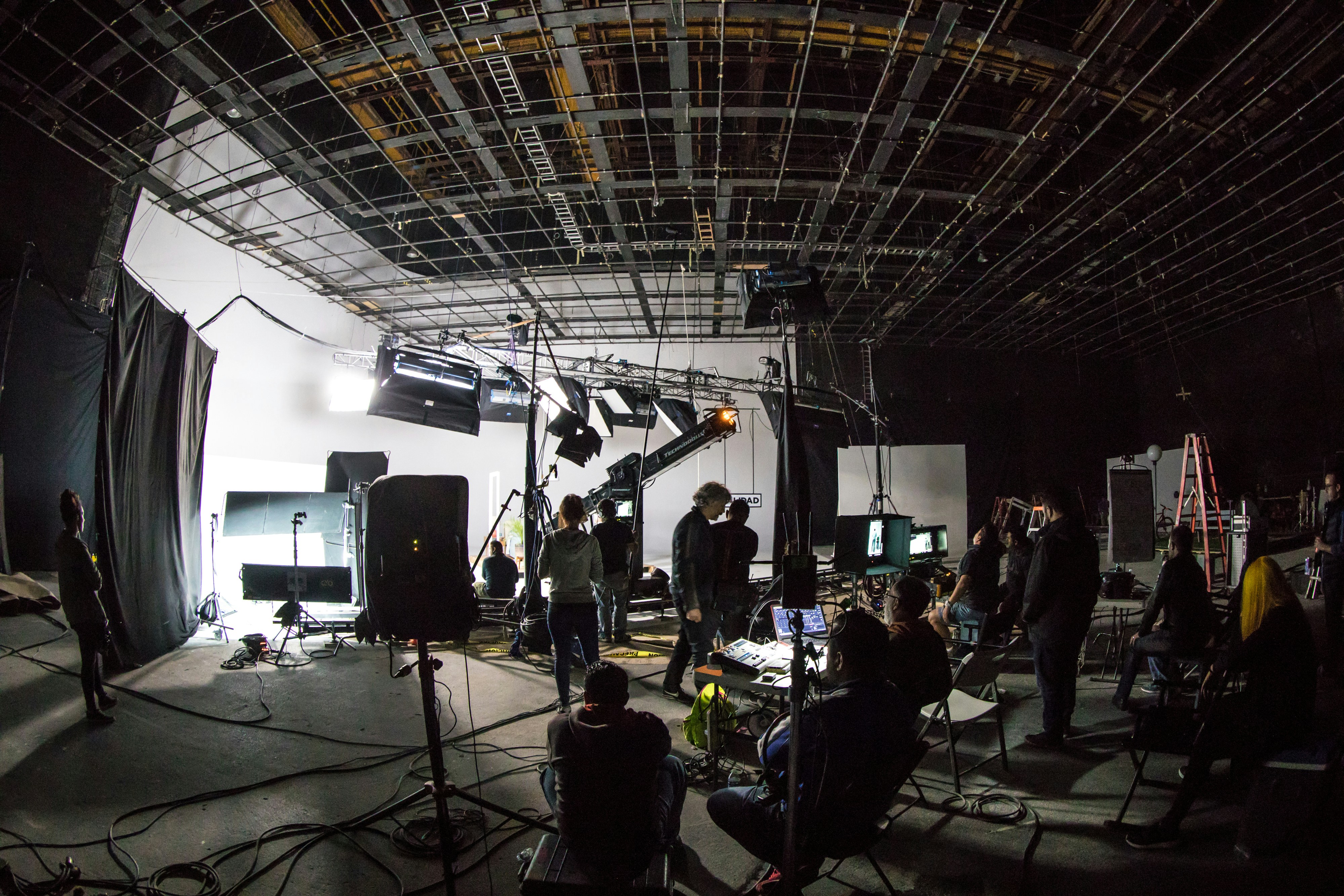
Do you want to know how professional live streams are really created and what technology and processes are behind them? In this article you will find out what a live direction is, where the term comes from and how you can use it at your next event to delight your audience with a cleanly produced stream.
The most important thing in brief
- A live direction produces the live stream of your event in real time: scene changes, lower thirds, transitions and background graphics.
- The direction plan is the central control document for the live direction and is based on the event agenda with exact times per scene.
- There are three production variants: on-site production, virtual live production and simple virtual broadcast (video call-to-stream).
- Which option is worthwhile depends on the budget, team size and desired production quality.
Who is this article aimed at?
This article is aimed at event managers who are planning a livestream for their hybrid or virtual event and are just getting started. You will find out how a live stream is produced with a live director, what a director's plan contains and which production variant suits your event.
Where does the term live direction come from?
The term comes from television and film production. The live control department refers to the area that is responsible for the coordination and implementation of live broadcasts. This includes selecting camera angles, giving stage directions to cameramen and other crew members, coordinating sound and lighting, and monitoring the entire process in real time.
The term has been transferred to the event sector: Anyone who produces a hybrid conference or online event today essentially works according to the same principles, just on a different scale.
What is live direction at an event?
In an online event or webinar, the live stream is what your participants see at the end. This livestream must be produced. Depending on the complexity, you can do this yourself or involve a service provider.
Basically there are two starting situations:
- On-site production: For example, you film a panel discussion on a stage with real cameras.
- Purely digital production: For example, you transfer a virtual panel from a video call.
In both cases, you can transmit the raw camera or video call image, or you can enhance it visually. We call this process of visual refinement live direction. The person who does this is the live director. She shows background slides, lower thirds and transitions live and follows the director's plan.
The director's plan: your tax document for the live director
The director's plan is the schedule for the live director. It is based on the agenda of your event, but goes much deeper: exact times, scenes and specific instructions for each scene are recorded in it.
A good control plan is clear and leaves room for spontaneous changes. When a panel discussion becomes heated and exciting, you need buffers to be able to react flexibly. Plan this buffer consciously.
Recommendation: Play through the stage plan completely before the event and test it live before the first real participant watches.
Example: Start of an online event
The public agenda only shows: event start at 9:00 a.m., introduction, lecture, panel discussion. That's enough for the participants.
The live director needs significantly more:
- 08:30, 09:00· Scene: Countdown screen · Instruction: Play background music
- 09:00, 09:10· Scene: Organizer alone · Instructions: Organizer moderates
- 09:10, 09:15· Scene: Organizer + Chairman of the Board · Instructions: Short handover on stage
- 09:15, 10:00· Scene: Chairman of the board alone · Instructions: Presentation, show lower third with name
- 10:00, 10:30· Scene: Panel as a whole + individuals · Instructions: Change scene depending on the speakerThis level of detail allows the live director to respond professionally and without delay.
Is live direction worth it for my event?
This depends on your event type, your budget and the impression you want. We have classified the three common variants according to effort and cost.
Variant 1: On-site live production
The most complex and expensive option. Real cameras, professional sound technology and an experienced service provider on site are used here. The result can reach television quality.
Suitable for: Large congresses, general meetings or events where production quality is an explicit quality signal. Costs for location, hardware and personnel add up quickly.
Variant 2: Virtual live production
High-quality live streams are also possible completely digitally. Live contributions, pre-produced videos, clean transitions, background graphics, lower thirds and appropriate music create a professional overall image.
The costs are significantly lower because there is no need for all the hardware on site. A live director is usually sufficient as an external service provider. This variant is the sweet spot for medium-budget hybrid B2B events.
Suitable for: Conferences, specialist meetings, internal company events with streaming components.
Variant 3: Virtual transmission (video call-to-stream)
The cheapest and self-implementable option. Your participants will be invited to a normal video call (e.g. Zoom, MS Teams or Google Meet), and the call will be broadcast directly as a live stream to your event platform.
Combined with your platform’s branding, this is completely sufficient for most events. The effort for you as the organizer is minimal; technical expertise is not absolutely necessary.
Suitable for: Webinars, internal training, smaller online events with tight budgets or small teams.
Implement live directing yourself: What you need
If you don't want to spend thousands of euros on a service provider, but still want to produce a high-quality live stream, that's realistic. With the right software and a direction plan, you can take on simple live direction yourself, even without in-depth technical know-how.
Typical tools for getting started with software-supported live directing:
- OBS Studio (free, open source) for scene changes, overlays and stream output
- StreamYard or Restream for browser-based production without installation
- vMix for more professional on-site setups with multiple cameras
There is also your event platform in which the finished stream is embedded.
Live direction and hybrid events: What you should pay attention to
At hybrid events where participants are present both on site and online, the live direction takes on a particularly important function: it ensures that the online audience gets an equivalent experience, not just a blurry camera image from the back of the hall.
Specific points that you should consider when using a hybrid setup:
- Separate camera just for the live stream (not the same one that the hall projector uses)
- Dedicated microphone setup for online transmission that minimizes room sound
- Lower thirds for speakers so online audiences see names and titles
- Clear visual transitions between scenes so changes don't seem abrupt
- Test run 30, 60 minutes before the start of the event with everyone involved
FAQ about live directing
What is the difference between a live production and a normal video call?
On a normal video call, you only see the raw camera feeds of the participants. A live control room refines this image in real time: it switches between scenes, displays text and graphics and ensures that the output looks like a professional production, not like a Zoom meeting.
Do I always need an external service provider for live production?
No. For simple virtual events, tools such as OBS Studio or StreamYard, which you can operate yourself, are sufficient. We recommend a service provider for on-site productions with multiple cameras or for events with very high quality standards, e.g. general meetings or specialist congresses with 1,000+ participants.
How much does a live production cost?
That depends heavily on the variant. A virtual transmission via video call costs practically nothing additional. A virtual live production with an external director costs between 500 and 2,500 euros, depending on the effort. A professional on-site production with cameraman, sound technology and direction can cost upwards of 5,000 euros.
What goes into a good directing plan?
A good production plan contains at least: exact times per scene, a short description of what can be seen in the picture, instructions for lower thirds and fade-ins as well as buffer times for handovers and spontaneous extensions. It is short enough to be readable under pressure and detailed enough that a new crew member could use it.
How does live directing differ between hybrid and purely virtual events?
For purely virtual events, you work exclusively with digital sources (webcams, screen shares, pre-produced videos). For hybrid events, physical cameras, stage technology and on-site logistics are added. This increases the complexity and makes a test run even more important.
Conclusion
Live direction is not a luxury that only TV stations can afford. With the right tools, you can produce a live stream that looks professional and impresses your participants, even on a small budget. The decision between on-site production, virtual live production and simple video call transmission depends primarily on how much effort you want to invest and what level of quality your event requires.
If you would like to know how to embed a live control directly into Streavent and offer your participants a consistent experience, I would like to book a demo. We'll show you what this looks like in practice.